This post is part of a series on contemporary questions in ECE globally. Read about the series as a whole, and find other articles by clicking here.
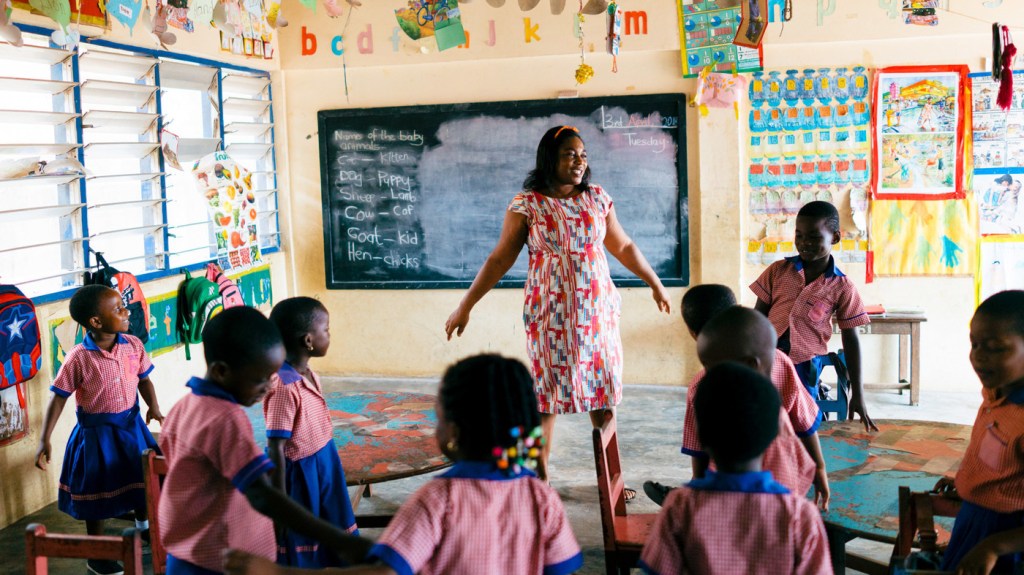
In 2018, NPR published a story covering the growing enrollment and shifting teaching practices of early childhood education in Ghana. Within the article, a teacher’s transformation from a highly didactic, repetition-driven approach to a more engaging, play-based approach is profiled, and parental opinions about the new pedagogic approaches are explored. (For more on shifts in pedagogy to child-centered methods, and why this is not inherently for the best, read this post). The author records one interaction with a father, who describes the academic, memorization-driven focus even in the early years of learning.
When we describe the scenes we’ve been seeing in Accra’s preschools to Herman Agbavor — the father who was doing homework with his son — he immediately nods in recognition. “Back in school we used to call it chew and pour,” he says. Meaning, for each possible question, the teacher gives you one correct answer to memorize — or “chew” — so that come test time, you can regurgitate it — “pour it” back to her verbatim.
Aizenman & Warner, 2018, “What We Can Learn From Ghana’s Obsession With Preschool”
This vignette highlights a trend that has trickled down from secondary and primary schools into early childhood settings in recent history, wherein more and more students are facing earlier and earlier timelines for academic learning and preparation. Daphna Bassok and other researchers at the University of Virginia described this “academizationa” phenomenon in an article titled “Is Kindergarten the New First Grade?.” Their research analyzed U.S. teacher attitudes regarding learning standards, and found that in many categories–particularly regarding a belief that children should read by the end of kindergarten–teachers’ beliefs about content and learning benchmarks that used to mark first grade educators have now come to characterize the beliefs of kindergarten teachers. The impacts of such beliefs are troubling: as standards of academic learning are pushed onto younger and younger children, the tests that are intended to indicate progress toward these standards are being emphasized for younger and younger children.
In a recent Brookings article, “A Prescription for Play: A Pediatrician’s Case for Resuscitating Play,” the startling truth about shifting childhood access to unstructured time in the United States was recently highlighted: “excising play through a 30 percent drop in recess coupled with a 29 percent rise in test preparation creates classroom contexts that are driven by narrowly didactic goals with even kindergarten classrooms having little or no time for play or choice time.” The article, written by Kathy Hirsh-Pasek, a leading early childhood researcher, and Michael Yogman, professor of pediatrics at Harvard Medical School, highlights what many early childhood educators know all too well: testing and accountability initiatives are pushing playful learning further and further out of the classroom, to the detriment of child health and wellbeing.
As many have described, educators are living in the “era of accountability” where test results form the basis of evaluation for students and teachers alike, tests are standardized, and largely resemble the “chew and pour” method of memorization and testing regurgitation that Mr. Agbavor described in Ghana. This not only is stressful for students, but minimizes the professional independence and agency of the educators in early childhood classrooms. In a field with low levels of professionalization, this is a critical issue.
Jal Mehta’s analysis of the American educational system’s accountability trends, The Allure of Order, highlights one particular change that could be transformative across educational systems: the professionalization of the teaching workforce. He recommends an approach that “inverts the pyramid” of accountability. At present, teachers are at the bottom, forced to instruct and assess content and standards over which they have little say and are held responsible for. However, putting teachers teaching workforce that is trained and compensated in a manner appropriate for educators, and in turn, educators are trusted with the education of their students, rather than micromanaged. The agency and professional identities of teachers are valued, rather than suppressed, under such a system. Mehta points out Finland as an example in this regard, describing how “Finland has vastly limited the role of centralized assessment and accountability…[but rather] selects its teachers carefully, invests heavily in training, and creates time and opportunity for them to collaborate.”
The Atlantic recently described, in a piece titled “The New Preschool is Crushing Kids” the same quality Mehta points out across the whole Finnish education system, but specific to ECE settings. The Finnish ECE teaching workforce has been transformed by “radically professionalizing” the workforce starting in the 1970s. The academic focus that has been found in settings around the world in increasing measure has been combatted effectively, as the authors describe:
Having rejected many of the pseudo-academic benchmarks that can, and do, fit on a scorecard, preschool teachers in Finland are free to focus on what’s really essential: their relationship with the growing child.
Here’s what the Finns, who don’t begin formal reading instruction until around age 7, have to say about preparing preschoolers to read: “The basis for the beginnings of literacy is that children have heard and listened … They have spoken and been spoken to, people have discussed [things] with them … They have asked questions and received answers.”
The Atlantic, Erika Christakis, 2016, “The New Preschool is Crushing Kids”
Of course, it is undeniable that in many contexts globally, early learning has been neglected and underinvested in. However, accountability pushes that centralize testing and academic gains for students at the expense of play and teacher autonomy do more harm than good in the effort to build systems of ECE. As international bodies begin to approach improving quality for the youngest learners in the world, the first step towards improving quality must begin with treating teachers as professionals and protecting the earliest years of childhood from the assessment-driven accountability initiatives that have been detrimental for primary school children globally. If playful, nurturing care is sacrificed on the altar of accountability and testing, the potential of ECE for transformation and global development will be greatly diminished.
Additional Resources:
UNICEF report, “Accountability in Education: Meeting Our Commitments“, Chapter 10 on Early Childhood Education
International Perspectives on Transition to School by Kay Margetts, Anna Kienig, 2013

