Data, Dilemmas and New Directions
This article is the second part of an analysis of international efforts to improve the quality of life and outcomes of young children globally. To read part 1, click here.
Where have 30 years of progress since UNCRC led? Data indicates mixed but hopeful progress. Below highlights specific areas of progress through the lens of data in several key domains of the UNCRC’s child rights
Mortality & Health
Since 1990, global under-five mortality has decreased 59%, with at least 40% reductions in every region. This is a massive decline that represents millions of lives saved since the 1990 benchmark at the beginning of MDG data tracking initiatives. However, improvements have been uneven, particularly when examining regional progress and poverty levels. The World Health Organization (WHO) published that “in 2018, the under-five mortality rate in low-income countries was 68 deaths per 1000 live births – almost 14 times the average rate in high-income countries (5 deaths per 1000 live births).”
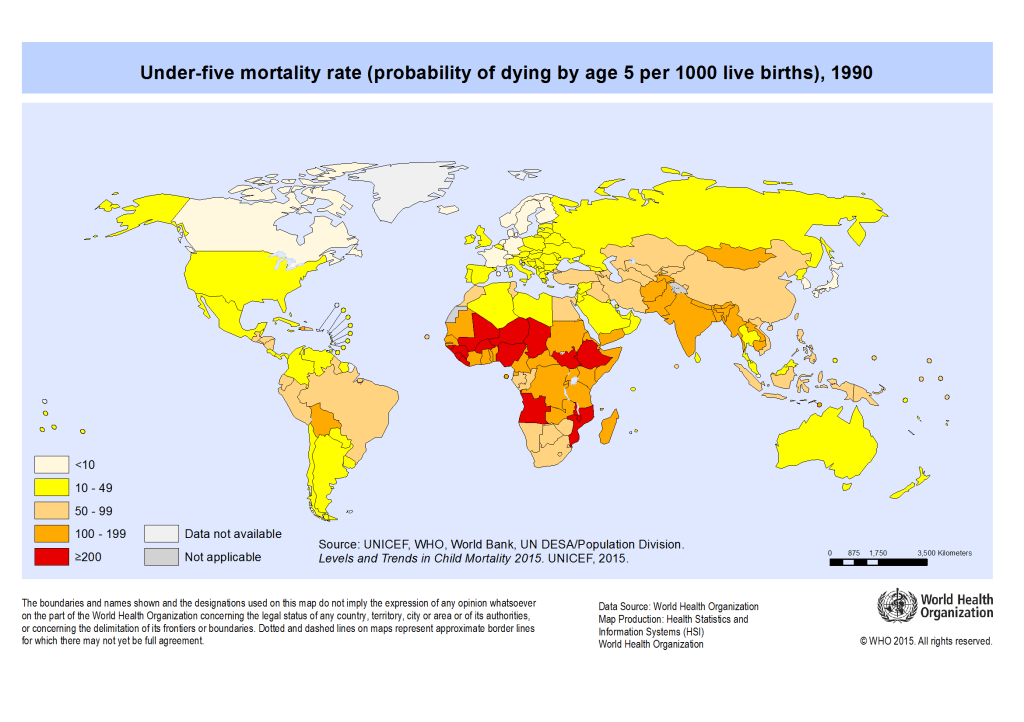
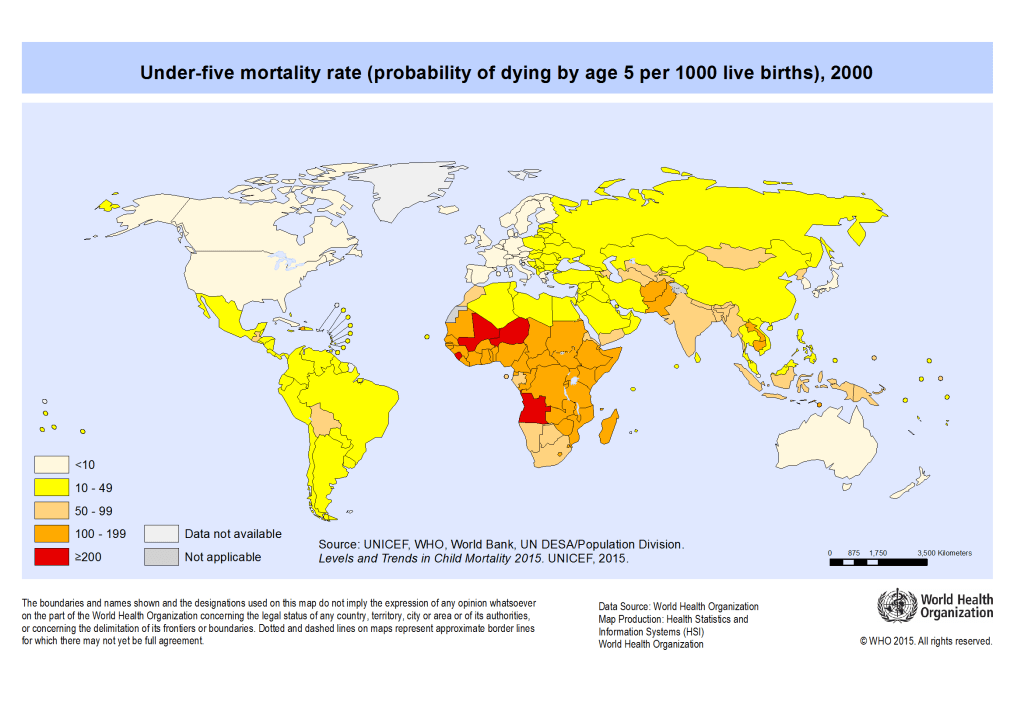
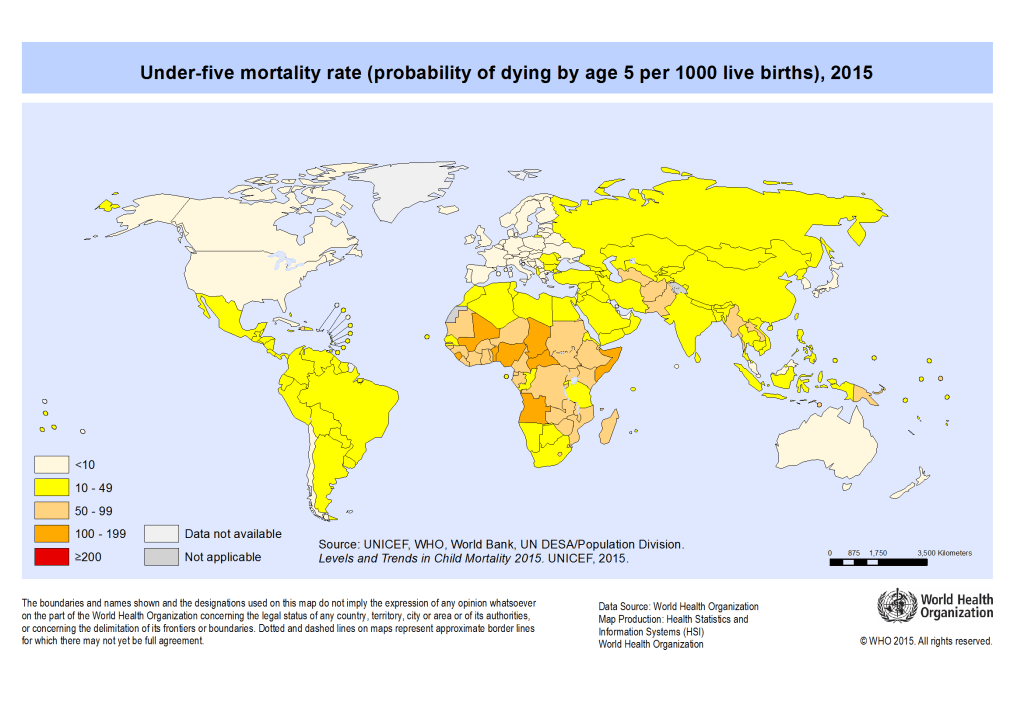
Despite progress, 15,000 children under 5 still die every day. The causes of these deaths are varied, but many are related to improper access to healthcare, vaccinations, and water and sanitation that could prevent disease. Young children continue to be impacted by forces much beyond their control. As the “Convention at a Crossroads” 2019 UNICEF report highlighted, “children younger than age 5 in countries experiencing protracted conflict are 20 times more likely to die from causes linked to unsafe water and sanitation than from direct violence.” Additionally, as population centers have shifted increasingly toward urban environments, and income inequality persists and widens in many major city centers, troubling patterns have emerged that disrupt assumptions that children in urban environments have inherently better access to healthcare and more positive outcomes.
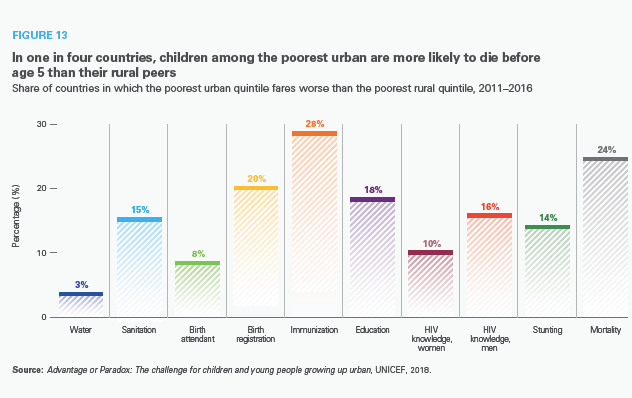
Additionally, several preventable diseases continue to affect young children disproportionately. Malaria continues to contribute significantly to the death of young children around the world, particularly in the sub-Saharan African region. Of 219 million malaria cases in 2017, 61% were children under five years old. When this data is broken down, it equates to the stark reality that every two minutes, a child under five dies of malaria. For families trying to maintain health for multiple children, malaria poses a real danger without proper access to care, and at a national scale, the impacts of the disease are a source of massive public expenditure.
Citizenship, Registered Births and Legal Status
As questions of citizenship, nationality, statelessness and migration have emerged as critical global discussions in recent decades, worth noting is the UNCRC’s seventh article, specifying that “the child shall be registered immediately after birth and shall have the right from birth to a name, the right to acquire a nationality and. as far as possible, the right to know and be cared for by his or her parents.” However, still one in four children under the age of five have never been formally registered. This has huge implications for access to medical care, legal protection, social services, education, and future property ownership through legal channels. UNICEF’s coverage of the current data highlights that “universal birth registration is also part of a system of vital statistics, which is essential for sound economic and social planning. Birth registration is therefore is not only a fundamental human right in and of itself, but also key to ensuring the fulfillment of all other rights.”
Early Childhood Education
As previously described, a holistic definition of early childhood development and care is essential to creating meaningful progress.
Bolstered by international attention and investment following the Millennium Development Goal 4, focused on increasing primary school enrollment, the Education for All (EFA) movement emerged and picked up speed throughout the early 2000s. In the era of the MDGs, primary school enrollment rates did indeed increase—while almost 20% of primary-school age children were out of school in 1990, now this number is less than 10% globally, according to the “For Every Child, Every Right” report by UNICEF for the 30th anniversary of the Convention on the Rights of the Child, as described in the last post.
However, many have criticized the goals, means, and impacts of the massive investment in this era of expanding enrollment. As Juan Carlos Barrón Pastor argues in Education and International Development (McCowan and Unterhalter, 2015), the push toward schooling can be seen as “part of the forces promoting non-development disguised as development … promoting consumption, competition, alienation and individualism” rather than “constructing knowledge for solidarity, respect and a more healthy conviviality for all living being alongside self-sufficient communities” (71). As the EFA movement pushed on toward its goals of enrollment, the international gaze turned toward increasing access to schooling, with noble intentions and a hopeful gaze toward the hypothetical outcomes of this increase in access. However, this emphasis promoted a limited version of transformation defined by a fixed goal: more students participating in formal education systems. In Hanushek and Kimko’s (2000) work to assess human capital impacts on economic development, schooling quality “boosts the explained variation in GDP per capita among thirty-one countries in their sample from 33% to 73%…[and] the effect of schooling ‘quantity’ is greatly reduced and largely insignificant” (McCowan and Unterhalter, 2015). Quality has, by many accounts, suffered under the consideration of increased schooling as the sole metric of success.
These errors should be noted and care must be taken to avoid similar pitfalls as the lens of international development efforts now shift toward eerily similar goals, but simply for younger children. If enrollment is again the target of success, the failures of the EFA movement that led to more students in chairs without meaningful learning will apply to younger students, missing a window of critically important quality environments, interactions, and access to services that can only transpire when quality is emphasized, not just quantity.
Tracking has already begun along the lines of enrollment as a metric of early childhood education, which, to be clear, has an important function. It is worthwhile to know who is in ECE, and where gaps in equitable access persist. Global participation in early care and education was 70% in 2016, an increase over 63% in 2010, based on UNICEF tracking of both care and preprimary education. The World Bank estimates for preprimary education specifically indicate roughly 51% global participation (see chart above). Regional progress varies, as was the case in MDGs, with sub-Saharan Africa at 41% and Northern Africa and Western Asia at 52% according to UNICEF data. While over 70% of OECD countries have “integrated early childhood education and care (ECEC services,” there is considerable variation in this group of countries as well among access to care for the youngest children: in Mexico and Turkey, less than 5% of children participate in ECEC under the age of 3, while in Denmark, Iceland, Israel, Luxembourg, Korea, the Netherlands, New Zealand and Norway this number is over 50%. Alongside this data, however, quality indicators must be valued and examined closely to make meaningful advances.
Conclusions
While the convention broadly addressed the rights of all children under the age of 18, the most vulnerable and voiceless of these children—those under the age of five—have been included to some extent in the progress of the past 30 years. Substantial attention and investment has been made in the earliest years of life, but there are still noticeable areas of failure and disparities between regions in progress, investment, and awareness about the critical importance of early childhood and its lifelong impacts. As investment in research and interventions regarding the earliest years of life have increased in number and deepened in rigor and impact, there is reason to be hopeful that early childhood outcomes are on a track to improving in the years to come. However, this can only come as we examine data carefully, and make critical decisions about how to track progress toward goals in meaningful ways that prize the health, safety, and thriving of each child through high-quality care and education and meaningful outcomes, not just easy-to-track inputs.
 The World of the Early Years: Global Early Childhood Education
One thought on “The State of Global Early Childhood, Part 2”