What’s in a Goal?: International Goal-Setting and Discourse on Childhood, Thirty Years After UNCRC
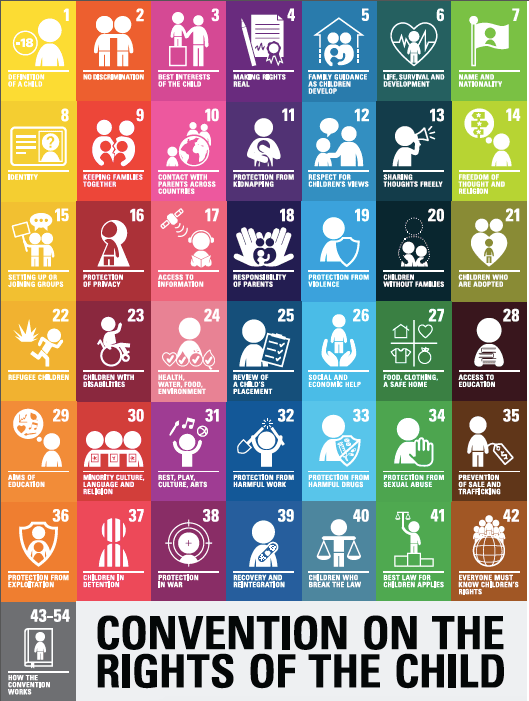
In 1990, the United Nations adopted the Convention on the Rights of the Child (UNCRC). It became the most widely-adopted human rights treaty in history and addressed protections for the physical health and safety, educational needs, legal rights and freedoms of children globally—though, notably, the United States alone has not yet signed it.
It includes such protections as the right to life , to be registered with official government processes at birth, to have a nationality, to express opinions, to access information and media, to choose their own religious affiliations, and to rest and play. It emphasizes protections against kidnapping, separation from families (unless harm is being done to the child), exploitation via human trafficking or use as a child soldier, sexual and physical abuse, and unsafe labor.
Additional emphasis, both in awareness and investment, came with the announcement of the Millennium Development Goals (MDGs) set forth in the United Nations Millennium Declaration of 2000. These goals added additional focus to specific areas such as universal primary education (MDG 2), reducing child mortality (MDG 4), and improving maternal health (MDG 5), along with other important health outcomes in diseases that affect many young children like malaria and HIV/AIDS (MDG 6). This global-scale “big push” (as Jeffery Sachs described the function of global investment for development, with drew its own set of criticisms) prioritized specific indicators of success, and targeted regions falling behind in these goals with additional attention toward meeting goals. Despite many justified criticisms of these efforts, which will be explored in Part 2 of this post, the discourse that has followed the MDGs has brought a new lens of attention and unprecedented level of international collaboration and information exchange that has brought childhood into an increasingly cemented place in international decision making.
In the 30 years since the UNCRC’s adoption, massive shifts in technology, access to information, environmental resources, climate, educational systems, and healthcare advances have changed the lives of children and families profoundly. Childhood looks different in many ways for millions of children around the world, and yet the core needs of young children remain unchanged: safety, medical care, nurturing care and supervision, basic physical provision and shelter, cognitive stimulation and opportunities to play and discover. How these needs are defined, quantified, and tracked, however, matters for how the international community ultimately determines what it means to get closer to protecting the rights of all young children.
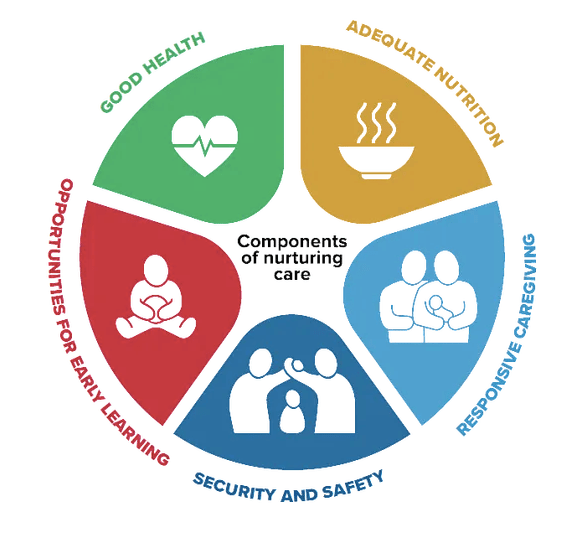
One effort to promote a holistic definition of child development is the Nurturing Care Framework, developed by UNICEF, WHO, and partner organizations to highlights these basic needs, which promotes a five-dimension construction of child development including good health, adequate nutrition, opportunities for early learning, security and safety, and responsive caregiving.
This framework is intended to specifically address the first three years of life as a critical period prior to most formal education settings where healthcare supports might serve the most effective means of intervening at a critical time of child development. These dimensions are not intended to be a simple intervention or the start of any singular policy, but rather are intended to be a starting point for national and international questioning of current approaches. In some ways, frameworks such as this one have emerged as a means of adding breadth to MDG goal-targeting efforts that were often critiqued as narrow in scope and limited in impact when detached from their idealistic aims.
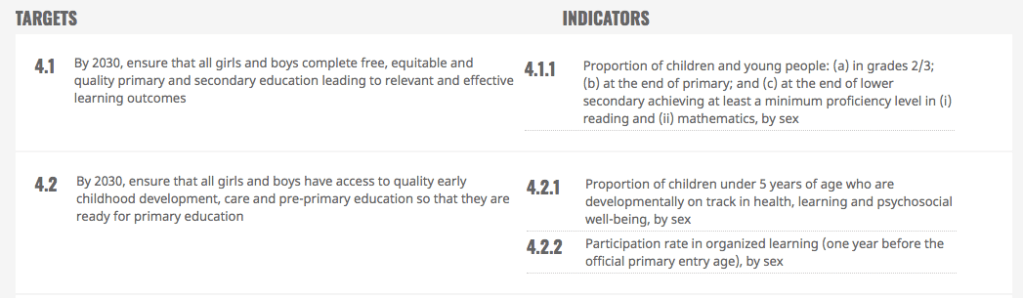
The Sustainable Development Goals (SDGs), announced only a few years ago, include two specific metrics tracking early childhood development, care, and education as a subset of SDG 4, the educationally targeted goal of the SDGs. While the SDGs have increased the visibility of early childhood through specific attention, if methods of tracking progress rely on thin definitions and surface-level indicators of what it means to be “developmentally on track in health, learning, and psychosocial well-being,” the SDGs will fail to adequately and meaningfully drive progress toward genuine quality of life improvements for the world’s youngest children. As scientific knowledge and public awareness continue to expand regarding the importance of the first five years of life and how to support child development, a robust framing of child development (such as that of the Nurturing Care Framework) that retains supportive adult relationships as a core component and does not look at any one metric in isolation will be a core component of achieving meaningful progress globally. Additionally, it is imperative that a robust level of investment in data collection efforts and progress monitoring accompanies this effort so that the complex care-related components of early childhood metrics are not cast aside in favor of easy-to-measure, but ultimately ineffective methods of assessing global progress toward ensuring the rights of all children to thrive.
So, considering the full picture of child well-being globally, how are children faring across these domains 30 years after the sweeping declaration of rights and protections made by the U.N., the era of the MDGs and the recent SDG-related efforts?
See Part 2 for a look at the data, what it reveals about the impacts of global investment and attention over the past thirty years, and the role of early childhood education in addressing areas where progress is critically needed.
Additional Resources:
To learn more about the history of children’s rights, click here.
For more on the 30 years of progress and next steps since the UNCRC, explore the UNICEF website and “Letter to the World’s Children” by Henrietta Fore, UNICEF’s executive director.
To read a children’s version of the UNCRC and share with a child in your life, click here.
 The World of the Early Years: Global Early Childhood Education
One thought on “The State of Global Early Childhood, Part 1”